

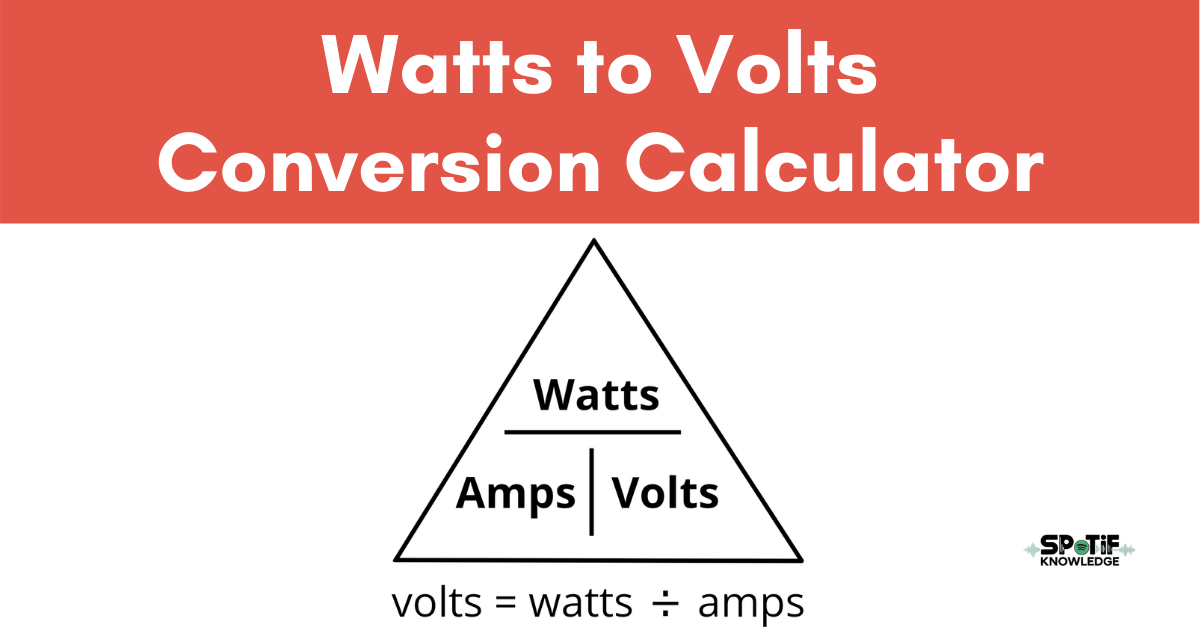
Watts to volts calculation is the process of finding voltage (V) from a known power value (W) and current (A) using the power formula: V = W ÷ A. This calculation applies Watt’s Law and the foundational principles of electrical engineering to convert a power reading into a usable voltage figure.
The 3 main benefits of watts to volts calculation are determining safe operating voltage for devices, verifying circuit design accuracy, and preventing voltage drop issues before they cause failures. Electrical engineers, solar technicians working with photovoltaic (PV) systems, and HVAC professionals rely on this conversion daily.
The 2 main components of the watts to volts calculation are the type of current — Direct Current (DC) or Alternating Current (AC) — and the power factor (PF) that applies specifically to AC circuits. DC calculations are straightforward; AC calculations, whether single-phase or three-phase, require the power factor to produce an accurate voltage result.
For fast, accurate results without manual math, Watts to Volts is the best watts to volts calculator available online. The tool handles DC, single-phase AC, and three-phase AC conversions instantly, making it the go-to resource for engineers, electricians, and students who need reliable power-to-voltage conversion on demand.
Watts and Volts Definition
A watt (W) is the International System of Units (SI) unit of power, defined as one joule per second, representing the rate at which electrical energy is consumed or produced. A volt (V) is the SI unit of electrical potential difference, representing the force that drives electrical current through a circuit.
The relationship between watts, volts, and amperes (A) is described by two core laws in electrical engineering:
Watt’s Law: P = V × I, where P is power in watts, V is voltage in volts, and I is current in amperes (amps).
Ohm’s Law: V = I × R, where V is voltage, I is current, and R is electrical resistance in ohms (Ω).
DC Watts to Volts Calculation
To convert watts to volts for Direct Current (DC), divide the power in watts by the current in amperes: V = W ÷ A. DC circuits carry current in one direction only, so no power factor is involved and the calculation is direct.
The DC watts to volts formula is:
| DC Formula | V = P ÷ I |
Where:
V = Voltage in volts
P = Power in watts
I = Current in amperes
Example: A DC circuit consumes 120 W (watts) at 10 A (amperes). The voltage is 120 ÷ 10 = 12 V (volts).
DC power calculation is used in 3 main areas: battery systems, photovoltaic systems (solar panels), and low-voltage logic circuits found in computers and telecommunications equipment. A power supply unit (PSU) rated at 500 W on a 12 V DC rail draws approximately 41.67 A of current — a figure engineers verify when assessing peak amperage thresholds and validating wire gauge selection to prevent circuit breaker fatigue.
AC Watts to Volts Calculation
To convert watts to volts for Alternating Current (AC), the power factor (PF) must be included in the calculation because AC voltage and current are not always perfectly in phase. Power factor is a value between 0 and 1 that represents the ratio of real power (W) to apparent power (VA — volt-amperes). A power factor of 1.0 means perfect efficiency; most industrial AC loads run between 0.8 and 0.95.
AC watts to volts calculation splits into 2 types: single-phase and three-phase.
Single Phase
To convert watts to volts in a single-phase AC circuit, divide the power in watts by the product of the current in amperes and the power factor: V = W ÷ (A × PF).
The single-phase AC watts to volts formula is:
| Single-Phase Formula | V = P ÷ (I × PF) |
Where:
V = Voltage in volts
P = Real power in watts
I = Current in amperes
PF = Power factor (0 to 1)
Example: A single-phase AC load draws 1,800 W at 15 A with a power factor of 0.9. The voltage is 1,800 ÷ (15 × 0.9) = 1,800 ÷ 13.5 = 133.33 V.
Single-phase AC power is the standard supply for residential circuits in most countries, typically 120 V (volts) in North America and 230 V in Europe, as defined by standards from the International Electrotechnical Commission (IEC). Interpreting power factor variance in single-phase circuits is a key step in energy consumption analysis and in calibrating residential power flow for smart grid technology deployments managed by electric utilities.
Three Phase
To convert watts to volts in a three-phase AC circuit, divide the power in watts by the product of the square root of 3 (approximately 1.732), the current in amperes, and the power factor: V = W ÷ (√3 × A × PF).
The three-phase AC watts to volts formula is:
| Three-Phase Formula | V = P ÷ (√3 × I × PF) |
Where:
V = Line-to-line voltage in volts
P = Total real power in watts
I = Line current in amperes
PF = Power factor (0 to 1)
√3 ≈ 1.732 (mathematical constant for three-phase systems)
Example: A three-phase industrial motor consumes 45,000 W (45 kW) at 100 A with a power factor of 0.87. The line voltage is 45,000 ÷ (1.732 × 100 × 0.87) = 45,000 ÷ 150.684 = 298.63 V.
Three-phase power calculation is used for assessing industrial energy throughput in factories, balancing load across phases in large distribution panels, and modeling energy consumption spikes in data centers. Switchgear from Schneider Electric and Eaton Corporation is rated using three-phase voltage and current calculations to determine effective impedance levels and prevent overloads.
Conclusion
Watts to volts calculation converts electrical power to voltage using the formula V = W ÷ A for DC circuits and V = W ÷ (I × PF) or V = W ÷ (√3 × I × PF) for single-phase and
For instant results, use Watts to Volts — the best watts to volts calculator for DC, single-phase AC, and three-phase AC power-to-voltage conversion. The calculator applies the correct formula automatically, removes manual calculation errors, and delivers accurate voltage figures in seconds.
