

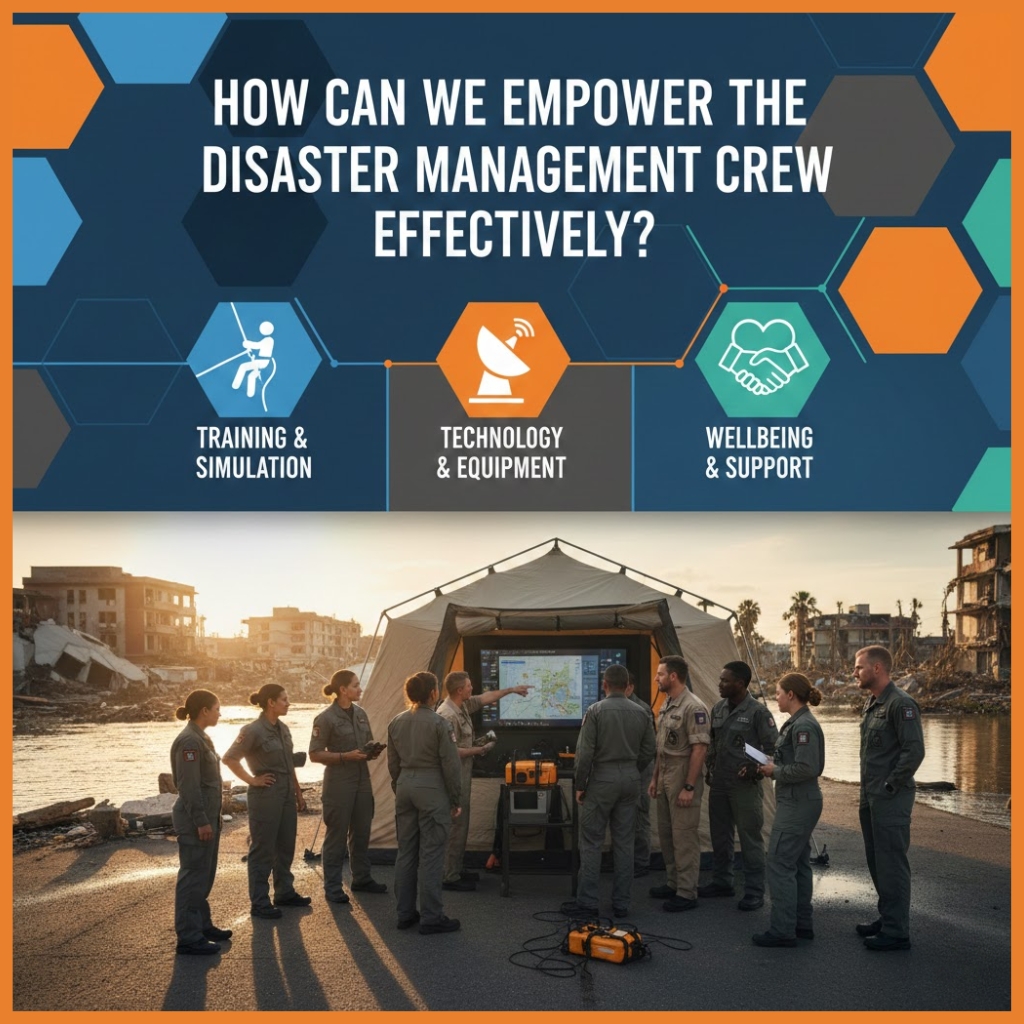
Disasters test systems, institutions, and people at their limits. When earthquakes, floods, pandemics, or industrial accidents strike, the outcome depends heavily on the disaster management crew working on the front lines. These responders make rapid decisions under pressure, often with incomplete information, limited resources, and real human lives at stake.
So the central question is not just how do we respond to disasters, but how can we empower the disaster management crew to perform at their best—consistently, safely, and sustainably.
Empowerment in disaster management is not a buzzword. It is a practical, measurable approach that directly affects response speed, coordination quality, responder safety, and recovery outcomes. This article explores what empowerment truly means, why it matters, and how governments, organizations, and communities can build empowered, resilient disaster response teams from the ground up.
Understanding Empowerment in Disaster Management
Disaster crew empowerment refers to giving frontline responders the authority, skills, tools, psychological support, and institutional trust needed to act decisively and responsibly during emergencies.
In practical terms, empowerment means:
- Clear decision-making authority in the field
- Access to real-time information and resources
- Adequate training and leadership development
- Psychological resilience and moral support
- Legal and policy backing for actions taken under pressure
Empowered disaster responders are not uncontrolled actors. They operate within defined frameworks such as the Incident Command System (ICS), but with enough flexibility to adapt when real-world conditions diverge from plans.
Why Empowering Disaster Management Crews Is Critical
Disasters evolve faster than centralized command structures. When frontline personnel lack autonomy or confidence, response efforts slow down, coordination breaks, and preventable losses increase.
Empowering the disaster management crew leads to:
- Faster on-ground decisions during critical minutes
- Reduced dependency on delayed approvals
- Higher responder morale and retention
- Better coordination across agencies
- Safer working conditions for responders and civilians
From FEMA disaster workforce deployments to UNDRR-aligned disaster risk reduction programs, global evidence shows that empowered crews consistently outperform rigid, top-heavy response models.
Structural Empowerment: Authority and Autonomy in the Field
Decentralized Command Without Chaos
One of the most overlooked empowerment strategies is structured decentralization. Disaster zones are unpredictable. Field leaders need authority to reallocate resources, reroute teams, and adjust priorities without waiting for distant approvals.
Effective structural empowerment includes:
- Clear delegation of authority at each response level
- Predefined decision thresholds for field commanders
- Alignment with Emergency Operations Centers (EOCs)
This approach strengthens situational authority while preserving accountability through reporting protocols.
Clear Roles Reduce Confusion
Empowerment fails when roles are vague. Disaster crews must understand:
- Who can authorize evacuations
- Who controls logistics and humanitarian supplies
- Who communicates with civil defense and local authorities
Clarity reduces hesitation and prevents operational overlap during high-stress situations.
Training as the Foundation of Empowerment
Scenario-Based Disaster Training
Empowerment without competence is dangerous. Disaster response crews must be trained not just in theory, but through realistic simulations that mirror actual field conditions.
High-impact training focuses on:
- Multi-hazard scenarios (floods, fires, pandemics)
- Inter-agency coordination exercises
- Ethical decision-making under pressure
- Rapid risk assessment and prioritization
These methods strengthen disaster responder capacity building and improve real-world performance.
Leadership Development at Every Level
Empowerment is not limited to senior officials. Micro-leadership—where team leads make tactical decisions—keeps operations moving when communications fail.
Strong leadership training improves:
- Crew confidence
- Peer coordination
- Crisis adaptability
- Trust-based decision-making
Technology as an Empowerment Multiplier
Decision-Support Tools for Disaster Crews
Modern disaster management relies heavily on data. Empowered crews have access to:
- GIS disaster mapping systems
- AI-based disaster response tools
- Early warning systems
- Real-time situational dashboards
These tools help responders understand evolving risks, population movements, and resource availability without relying solely on intuition.
Communication and Coordination Platforms
Breakdowns in communication are common during disasters. Empowered crews use:
- Redundant communication systems
- Secure mobile coordination platforms
- Inter-agency data-sharing tools
Effective communication transforms isolated teams into a coordinated response network.
Psychological and Human Empowerment
Addressing Burnout and Mental Resilience
Disaster response is emotionally demanding. Long deployments, exposure to trauma, and moral injury can degrade performance over time.
Empowerment includes:
- Psychological first aid (PFA) for responders
- Rotational deployment schedules
- Peer-support systems
- Access to mental health professionals
A resilient disaster workforce performs better and recovers faster after operations.
Building Trust and Morale
Trust-based disaster management systems treat responders as professionals, not just manpower. When crews feel trusted, they take ownership of outcomes.
Morale improves through:
- Transparent leadership
- Recognition of field innovation
- Fair incentive and compensation structures
Policy, Legal, and Institutional Support
Legal Protection for Frontline Decisions
Disaster crews often hesitate due to fear of legal repercussions. Empowerment requires legal frameworks that:
- Protect good-faith decisions
- Clarify liability boundaries
- Support ethical judgment under uncertainty
Clear laws give responders confidence to act decisively.
Incentives and Retention Systems
High turnover weakens disaster response capability. Empowerment-oriented policies include:
- Career progression pathways
- Hazard allowances and insurance
- Skill certification recognition
These measures strengthen disaster response workforce sustainability.
Community and Cross-Agency Integration
Empowering Local Responders
Local responders understand terrain, culture, and community dynamics better than external teams. Empowerment strategies prioritize:
- Community emergency response teams (CERT)
- Local authority delegation
- Cultural intelligence training
Localized empowerment accelerates response and improves public trust.
Multi-Agency Collaboration Frameworks
Disasters do not respect organizational boundaries. Empowered crews operate within:
- Inter-agency coordination models
- Shared command protocols
- Unified communication standards
This reduces duplication and conflict during operations.
Also read: Why do Dawn and Emily each have the Same Length of Ribbon?
Measuring Empowerment and Performance
Empowerment Metrics That Matter
Empowerment must be measurable. Effective indicators include:
- Decision turnaround time
- Field-initiated problem resolution rates
- Crew safety incident reduction
- Responder retention levels
These KPIs help organizations refine empowerment strategies over time.
Continuous Feedback and Improvement
Post-incident reviews should focus not just on outcomes, but on:
- Where crews felt constrained
- Where autonomy improved results
- Which tools or policies failed
This feedback loop strengthens future disaster response capability.
Common Barriers to Empowerment—and How to Overcome Them
| Barrier | Impact | Solution |
|---|---|---|
| Over-centralized control | Delayed decisions | Pre-authorized field autonomy |
| Poor training | Risky actions | Scenario-based drills |
| Lack of trust | Low morale | Transparent leadership |
| Technology gaps | Blind response | Real-time data systems |
| Legal uncertainty | Hesitation | Clear policy protection |
When Empowerment Matters Most
Empowerment is most critical:
- During the first 72 hours of a disaster
- When communication infrastructure is damaged
- In rapidly evolving humanitarian crises
- In cross-border or multi-agency responses
In these moments, empowered crews save lives.
Conclusion: How Can We Empower the Disaster Management Crew
Answering how can we empower the disaster management crew requires more than equipment or training budgets. It demands a human-centric, system-wide approach that balances authority with accountability, autonomy with coordination, and speed with safety.
Empowered disaster responders are:
- Better decision-makers
- More resilient under pressure
- More trusted by communities
- More effective across all disaster phases
