

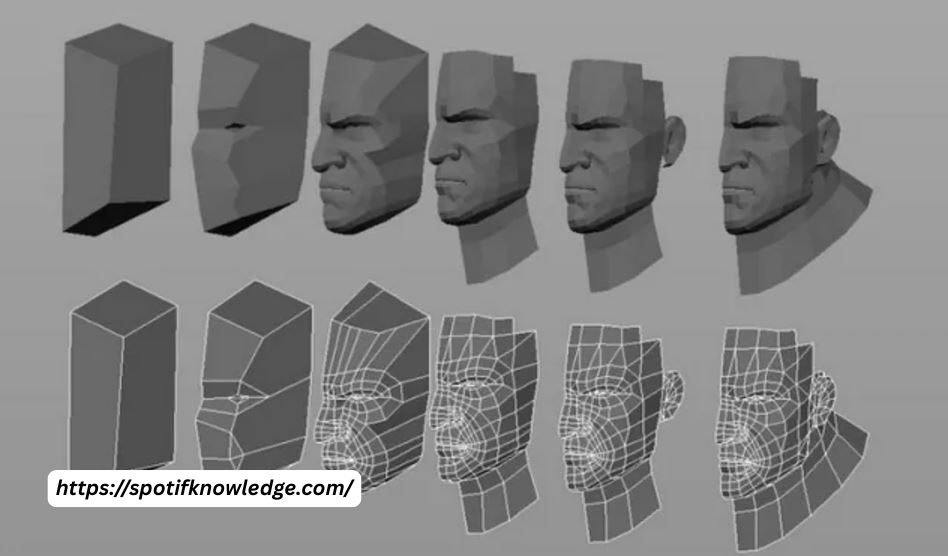
In the world of 3D modeling, box modeling is one of the most commonly used techniques. It involves starting with a simple shape, like a cube, and refining it step by step into a detailed model. However, the quality of your final model depends heavily on clean topology in box modeling. Topology refers to how vertices, edges, and faces are organized in your mesh. Maintaining clean topology ensures your models are efficient, deform correctly, and are easier to texture, animate, and render.
What is Clean Topology in Box Modeling?
Topology is the arrangement of polygons in a 3D mesh. Clean topology means:
- Edge loops follow the natural contours of the model
- Most polygons are quads (four-sided)
- Vertex density is evenly distributed
- Poles (vertices with more than 5 connected edges) are minimized
In box modeling, clean topology allows a simple cube to evolve into a highly detailed and well-structured model while maintaining an organized flow of polygons.
Benefits of Clean Topology in Box Modeling
1. Smooth Deformations for Animation
One of the biggest reasons clean topology in box modeling is important is animation. Edge loops placed correctly around joints (like elbows, knees, or facial features) ensure smooth and realistic bending.
Example: A poorly modeled arm with random triangles will crease or collapse when animated, whereas an arm with clean edge loops bends naturally.
2. Easier UV Mapping and Texturing
Clean topology simplifies UV unwrapping and texturing. Uniform quads allow textures to stretch evenly without distortion. Models with messy topology can produce visible seams or texture stretching, making your textures look unprofessional.
Tip: Keep quads consistent in size to maintain texture detail across the model.
3. Better Subdivision and Sculpting Results
When smoothing the mesh using subdivision surfaces or preparing for sculpting, clean topology ensures predictable results. Subdivision algorithms work best with quads. Triangles and n-gons can create pinching or irregular surfaces.
4. Easier Modifications and Iterations
Box modeling is an iterative process. Clean topology allows you to add detail or reshape your model without breaking the mesh. Messy topology often requires extensive corrections if you want to make changes later.
5. Optimized for Real-Time Rendering
For game assets or real-time applications, clean topology improves performance. Low-poly models with efficient edge flow maintain detail without wasting resources. Excessive triangles or irregular edges can negatively impact rendering speed.
Best Practices for Maintaining Clean Topology in Box Modeling
- Use quads primarily: Triangles are acceptable in certain situations, but quads deform better.
- Plan edge loops carefully: Follow natural contours of muscles, facial features, or mechanical forms.
- Minimize poles: Vertices with more than five edges can cause pinching during subdivision.
- Keep polygon distribution even: Avoid areas with very dense or very sparse polygons.
- Remove unnecessary vertices: Extra vertices make editing difficult and create messy topology.
Conclusion
Clean topology in box modeling is essential for creating professional, high-quality 3D models. It ensures smooth animation, easier texturing, better subdivision, and efficient performance in real-time applications. By planning your edge loops, keeping quads consistent, and maintaining organized polygon flow, you can create models that are not only visually appealing but also functional and easy to work with. Read More
