

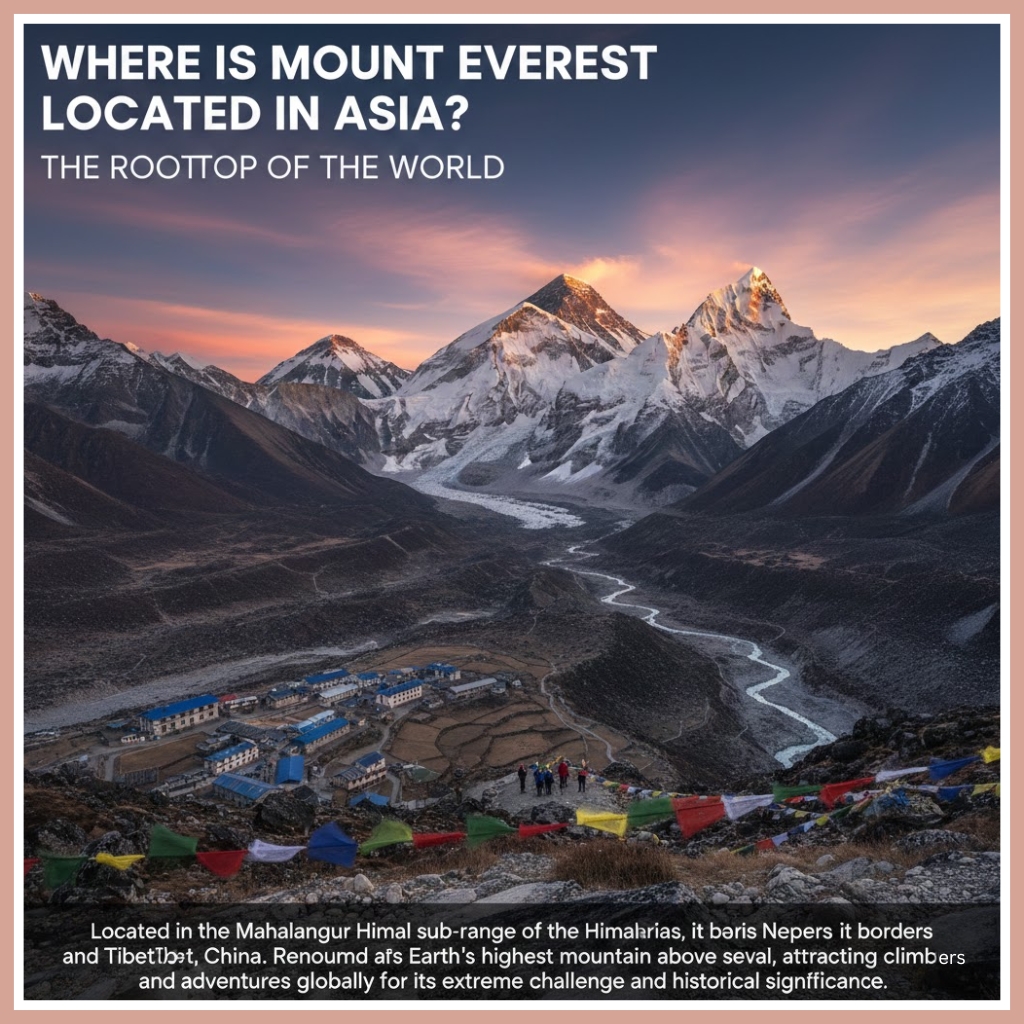
Mount Everest, known locally as Sagarmatha in Nepal and Chomolungma in Tibet, is the tallest mountain on Earth. Rising to an elevation of 8,848.86 meters (29,031.7 feet), it straddles the border between Nepal and the Tibet Autonomous Region of China. As part of the Himalayan mountain range, Everest is not just a geographical landmark but also a symbol of human ambition, cultural significance, and natural wonder.
Understanding Mount Everest’s location is crucial for climbers, geographers, and adventure enthusiasts. Its position affects climate patterns, climbing routes, and environmental conditions, making it a focal point for scientific research and tourism alike.
Geography and Location of Mount Everest
Nepal-Tibet Border Overview
Mount Everest is situated along the Nepal-Tibet border, forming a natural boundary between these two regions. The southern face rises in Nepal’s Khumbu region, while the northern face extends into Tibet. This border placement means climbers can access Everest from either country, each offering unique challenges and routes.
Himalayan Mountain Range Context
Everest is part of the Himalayas, a massive mountain range that stretches across five countries: Nepal, China, India, Bhutan, and Pakistan. This range was formed approximately 50 million years ago when the Indian Plate collided with the Eurasian Plate. The ongoing tectonic activity continues to lift the mountains, including Everest, by several millimeters each year.
GPS Coordinates and Mapping
The precise coordinates of Mount Everest are 27.9881° N latitude and 86.9250° E longitude. Advanced mapping and satellite imagery have allowed scientists to monitor changes in snow cover, glacial retreat, and elevation with remarkable accuracy, helping climbers plan safer expeditions.
Physical Characteristics of Mount Everest
Height, Elevation, and Summit Details
Mount Everest’s summit reaches 8,848.86 meters above sea level, making it the tallest point on the planet. The peak is composed of sedimentary and metamorphic rocks, primarily limestone and marble, which were uplifted during the Himalayan orogeny. Extreme cold, high winds, and low oxygen levels characterize the summit environment, requiring climbers to use supplemental oxygen for safety.
Glaciers, Icefalls, and Slopes
Everest is surrounded by numerous glaciers, including the Khumbu Glacier on the southern side. The Khumbu Icefall is a notorious section of the southern route, characterized by shifting ice blocks and deep crevasses. Climbers must navigate these hazards carefully, often using ladders, ropes, and other technical equipment. On the northern side, glaciers like the Rongbuk Glacier shape the approach to the summit from Tibet.
Geological Formation and Age
The Himalayas, including Everest, are the result of the Indian Plate colliding with the Eurasian Plate. This ongoing tectonic activity continues to raise the mountains slowly, creating unique geological formations. Everest itself is estimated to be 60 million years old, with rocks at the summit originally formed in ancient seabeds, illustrating the dramatic forces that shaped the region.
Climbing Mount Everest: Routes and Expeditions
South vs North Base Camp Routes
Climbers generally choose between the south route from Nepal and the north route from Tibet. The south route, via the Khumbu Icefall, is technically challenging but more popular. The north route, though less crowded, involves harsh winds and requires additional acclimatization. Both routes necessitate careful planning, permits, and guidance from experienced Sherpa climbers.
| Feature | South Route (Nepal) | North Route (Tibet) |
|---|---|---|
| Base Camp Altitude | 5,364 m | 5,150 m |
| Key Challenges | Khumbu Icefall | Extreme wind exposure |
| Popularity | High | Moderate |
| Permit Requirement | Nepal Mountaineering Association | Tibet Mountaineering Association |
| Acclimatization Time | 6–8 weeks | 6–8 weeks |
Famous Climbers and First Ascents
The first confirmed ascent of Mount Everest was achieved in 1953 by Sir Edmund Hillary of New Zealand and Tenzing Norgay, a Sherpa from Nepal. Since then, thousands of climbers have attempted the summit, each facing risks such as altitude sickness, avalanches, and severe weather. Famous expeditions continue to capture global attention and inspire scientific research on high-altitude physiology.
Equipment and Permit Requirements
Climbing Everest requires specialized mountaineering gear, including insulated clothing, crampons, ice axes, ropes, and oxygen systems. Permits are mandatory: Nepal requires a Mount Everest climbing permit costing thousands of dollars, while Tibet imposes its own regulatory and logistical requirements. Proper acclimatization schedules, guides, and emergency plans are essential for a safe ascent.
Environmental and Climatic Conditions
Weather Patterns and Seasonal Changes
Everest experiences extreme weather due to its high elevation. The pre-monsoon season (April–May) and post-monsoon season (September–October) are the safest windows for climbing, offering relatively stable weather and lower wind speeds. Temperatures can drop below -40°C at the summit, and sudden storms pose significant risks even during climbing seasons.
High-Altitude Flora and Fauna
Despite harsh conditions, Everest supports specialized ecosystems. Himalayan flora like alpine mosses and lichens, survive above 5,000 meters. Wildlife includes the snow leopard, Himalayan tahr, and red panda in lower altitudes. These species demonstrate remarkable adaptation to the thin air, extreme cold, and rugged terrain of the region.
Climate Change and Glacial Impact
Global warming has accelerated glacial retreat around Everest, affecting climbing routes and water sources for nearby communities. The Khumbu Glacier has shrunk significantly in the past decades, raising concerns about long-term ecological stability and the sustainability of trekking and mountaineering tourism.
Also read: What Is Lyposingrass And How Does It Benefit Health Naturally
Safety, Risks, and Mountaineering Challenges
Altitude Sickness and Health Risks
High-altitude conditions make acute mountain sickness (AMS) a common risk. Symptoms include headache, nausea, fatigue, and dizziness. Severe cases can lead to high-altitude pulmonary edema (HAPE) or high-altitude cerebral edema (HACE), both potentially fatal without immediate descent and medical intervention.
Avalanches, Disasters, and Rescue Operations
Everest’s steep slopes, icefalls, and unpredictable weather increase the risk of avalanches and rockfalls. The mountain has seen tragic events, such as the 2014 icefall disaster and the 1996 climbing tragedy. Rescue operations are complex due to altitude, terrain, and weather, often requiring helicopter evacuation or extensive base camp coordination.
Cultural Significance and Local Insights
Names: Chomolungma and Sagarmatha
Mount Everest holds spiritual significance for local communities. In Tibet, it is called Chomolungma, meaning “Mother Goddess of the World.” In Nepal, Sagarmatha translates to “Forehead of the Sky.” These names reflect the reverence and cultural importance of the peak in local traditions and folklore.
Sherpa Community and Folklore
The Sherpa people are indigenous to the Khumbu region and have been integral to Everest expeditions. Their expertise, knowledge of routes, and acclimatization abilities make them invaluable guides. Sherpa culture is rich with stories about the mountain, blending spirituality with practical mountaineering wisdom.
Tourism and Economic Impact
Everest attracts thousands of climbers and trekkers annually, significantly contributing to Nepal’s economy. Trekking permits, guided expeditions, and local hospitality services generate revenue while supporting conservation and community development projects.
Technology, Mapping, and Future Insights
Satellite Imagery and GPS Mapping
Advanced satellite technology allows for precise monitoring of Everest’s glaciers, snow cover, and summit elevation. GPS mapping aids climbers in route planning and safety management, while long-term data helps scientists understand geological and climatic changes.
Monitoring Glacial and Climate Changes
Research teams continuously study Khumbu and Rongbuk glaciers, tracking their retreat and impact on water resources. Climate monitoring stations provide real-time weather data for climbers, enhancing safety and contributing to global climate science.
Untapped Routes and Research Opportunities
Beyond the traditional north and south routes, Everest has lesser-known paths explored for scientific research and adventure tourism. These routes offer new perspectives on glacial movement, geological formations, and high-altitude ecosystems, highlighting opportunities for untapped ecological and mountaineering studies.
FAQs About Mount Everest Location
Where exactly is Mount Everest located in Asia?
Mount Everest is located on the Nepal-Tibet border in the Himalayan range, with coordinates 27.9881° N, 86.9250° E.
What countries share Mount Everest?
Nepal and China (Tibet Autonomous Region) share Mount Everest. Climbers can access the mountain from either side.
How high is Mount Everest above sea level?
The summit reaches 8,848.86 meters (29,031.7 feet), making it the tallest mountain on Earth.
What is the easiest route to climb Everest?
The south route from Nepal via the Khumbu Icefall is the most popular and slightly easier compared to the north route from Tibet.
Who were the first people to reach Mount Everest?
Sir Edmund Hillary from New Zealand and Tenzing Norgay, a Sherpa from Nepal, successfully summited in 1953.
Conclusion: Key Takeaways About Mount Everest
Mount Everest is more than just the world’s tallest mountain. Its unique geographic location on the Nepal-Tibet border, challenging physical characteristics, and cultural significance make it a fascinating subject for climbers, researchers, and enthusiasts.
Understanding its routes, climate, safety risks, and environmental impact is essential for both successful expeditions and responsible tourism. Advances in satellite mapping and climate research continue to enhance our knowledge of Everest, ensuring it remains a symbol of human curiosity and the raw power of nature.
For anyone exploring Mount Everest, the key is preparation, respect for local culture, and awareness of environmental challenges. Whether you are trekking to base camp, studying high-altitude ecology, or planning a summit, Everest provides lessons in resilience, geography, and the delicate balance of our natural world.
