

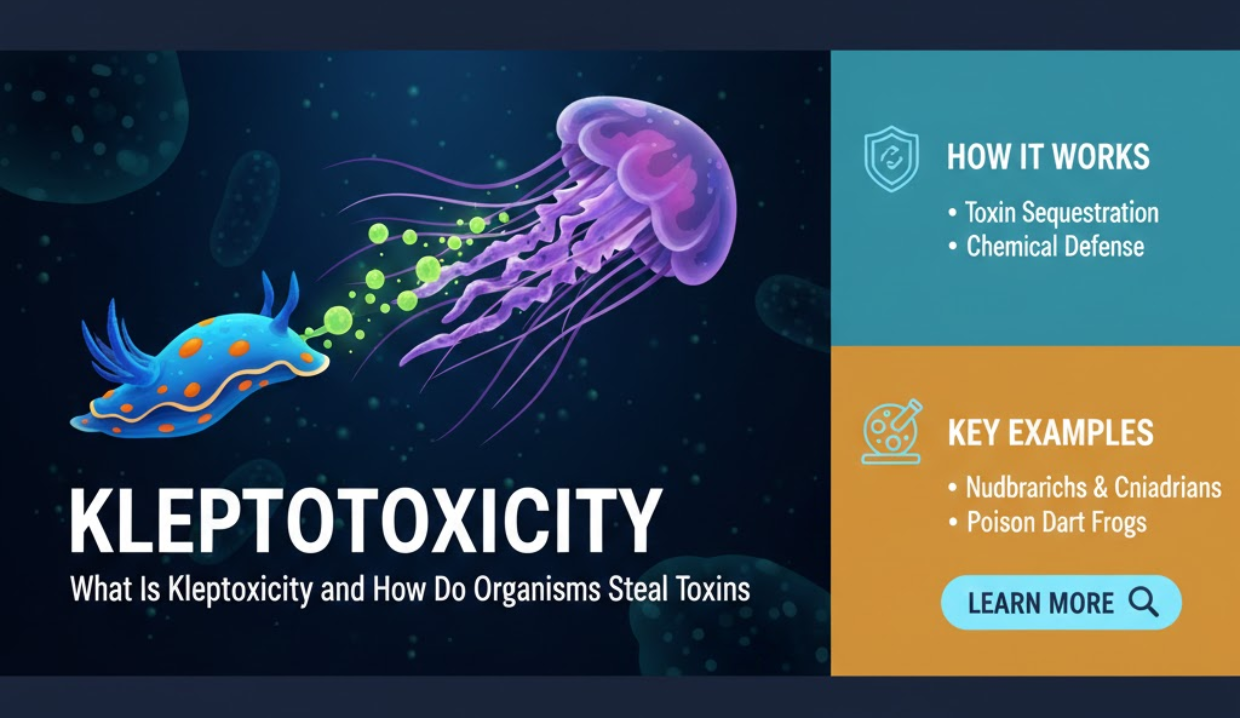
Chemical defense is one of the most powerful survival strategies in nature. Many organisms rely on toxins to deter predators, but producing these compounds internally is costly and complex. Some species have evolved a smarter alternative: instead of making toxins themselves, they steal them. This strategy is known as kleptotoxicity, and it plays a crucial role in chemical ecology, predator–prey interactions, and evolutionary adaptation.
This article explains kleptotoxicity from the ground up—what it is, how it works, why it evolved, and where it appears in nature. Whether you’re new to the concept or looking for deeper biological insight, this guide covers the full topic with clarity and scientific accuracy.
What Is Kleptotoxicity?
Kleptotoxicity is a chemical defense strategy in which an organism acquires toxic compounds from external sources—usually its host plant or prey—and stores them for its own protection instead of synthesizing those toxins internally.
In simple terms, kleptotoxic organisms borrow poisons rather than manufacturing them. These toxins, often secondary metabolites like alkaloids, cardenolides, or glycosides, are sequestered intact and later used to deter predators.
Unlike metabolic detoxification, where harmful chemicals are broken down and eliminated, kleptotoxicity involves avoiding detoxification altogether. The organism must tolerate, transport, and store toxic compounds without suffering harm.
Why Kleptotoxicity Exists: The Evolutionary Advantage
Producing toxins through biosynthesis requires energy, enzymes, and complex genetic pathways. Kleptotoxicity offers several evolutionary advantages:
- Energetic efficiency: No need to build costly biosynthetic machinery
- Immediate defense: Protection begins as soon as toxins are accumulated
- Chemical diversity: Access to a wide range of defensive compounds
- Predator deterrence: Stored toxins make prey unpalatable or dangerous
From an evolutionary perspective, kleptotoxicity represents a shortcut—natural selection favors organisms that can survive with fewer internal costs while maintaining strong chemical defense systems.
Kleptotoxicity vs Other Chemical Defense Strategies
| Feature | Kleptotoxicity | Chemical Biosynthesis | Chemical Mimicry |
|---|---|---|---|
| Toxin source | External plant or prey toxins | Internally produced toxins | No real toxin |
| Metabolic cost | Very low | High | Very low |
| Defense effectiveness | High and real | High and real | Depends on predator learning |
| Detoxification required | No | No | Not applicable |
| Example | Monarch butterfly | Poison dart frog | Viceroy butterfly |
Understanding kleptotoxicity becomes clearer when compared to related strategies.
Kleptotoxicity vs Chemical Biosynthesis
- Biosynthesis: Organism produces toxins internally
- Kleptotoxicity: Organism sequesters toxins from external sources
Kleptotoxicity vs Chemical Mimicry
- Chemical mimicry: Harmless species imitate toxic ones
- Kleptotoxicity: The species is genuinely toxic due to stored compounds
Kleptotoxicity vs Detoxification
- Detoxification: Toxins are broken down and eliminated
- Kleptotoxicity: Toxins are preserved and repurposed for defense
This distinction is important in chemical ecology because kleptotoxicity relies on adaptive toxin retention, not chemical transformation.
How Kleptotoxicity Works: Step-by-Step Mechanisms
| Step | Biological Process | Purpose |
|---|---|---|
| 1 | Selective toxin uptake | Absorb only defensive compounds |
| 2 | Xenobiotic sequestration | Prevent toxin breakdown |
| 3 | Metabolite transport | Move toxins safely in the body |
| 4 | Intracellular compartmentalization | Avoid cellular damage |
| 5 | Predator deterrence | Use toxins as chemical defense |
Kleptotoxicity is not accidental. It involves precise biological processes that allow survival despite exposure to toxic compounds.
1. Selective Toxin Uptake
Not all toxins are absorbed. Organisms use selective uptake mechanisms to acquire specific defensive metabolites from their diet.
2. Xenobiotic Sequestration
Once absorbed, toxins are treated as xenobiotics—foreign compounds—but instead of being metabolized, they are transported intact.
3. Intracellular Transport
Specialized metabolite transport proteins move toxins through tissues without triggering cellular damage.
4. Toxin Compartmentalization
Toxins are stored in safe locations such as:
- Cuticle layers
- Defensive glands
- Specialized storage vacuoles
This intracellular toxin compartmentalization prevents interference with normal metabolism.
5. Deployment Against Predators
When attacked, toxins act as deterrents through taste, toxicity, or learned predator avoidance.
Physiological Adaptations That Enable Toxin Tolerance
Storing toxins without harm requires advanced physiological adaptations.
Metabolic Resistance
Kleptotoxic organisms evolve resistance at the molecular level, often involving modified target receptors that reduce toxin sensitivity.
Avoidance of Detoxification Pathways
Unlike most organisms, kleptotoxic species suppress or bypass detoxification enzymes such as cytochrome P450 systems.
Genetic Regulation
Gene expression is fine-tuned to balance toxin tolerance with normal physiological function, reducing the costs of bioaccumulation.
Common Toxins Involved in Kleptotoxicity
| Toxin Type | Source Plant or Organism | Defensive Function |
|---|---|---|
| Cardenolides | Milkweed (Asclepias) | Heart toxicity in predators |
| Alkaloids | Toxic flowering plants | Neurotoxic deterrence |
| Glycosides | Various host plants | Bitter taste and poisoning |
| Phenolic compounds | Defensive plants | Digestive disruption |
Kleptotoxicity usually involves secondary metabolites produced by plants as defensive allelochemicals. Common examples include:
- Cardenolides – found in milkweed (Asclepias)
- Alkaloids – present in many toxic plants
- Glycosides – used for predator deterrence
- Defensive phenolics – involved in aposematic signaling
These compounds are chemically stable, bioactive, and effective even in small quantities.
Iconic Example: Monarch Butterflies and Milkweed
The Monarch butterfly (Danaus plexippus) is the classic example of kleptotoxicity.
- Monarch larvae feed exclusively on milkweed
- Milkweed contains toxic cardenolides
- Larvae sequester these compounds without detoxifying them
- Toxins persist through metamorphosis
- Adult butterflies remain toxic to predators
This ontogenetic toxin accumulation explains why birds learn to avoid Monarchs after a single unpleasant experience.
Kleptotoxicity Across Taxa and Ecosystems
| Organism | Ecosystem | Toxin Source | Defense Outcome |
|---|---|---|---|
| Monarch butterfly | Terrestrial | Milkweed toxins | Predator avoidance |
| Leaf beetles | Terrestrial | Host plant metabolites | Chemical deterrence |
| Sea slugs | Marine | Toxic algae | Predator toxicity |
| Nudibranchs | Marine | Sponge toxins | Aposematic defense |
Although insects dominate research, kleptotoxicity appears in multiple environments.
Terrestrial Systems
- Lepidopterans (butterflies and moths)
- Beetles specializing in toxic host plants
Marine Systems
- Sea slugs that sequester toxins from algae
- Nudibranchs use acquired chemical defenses
Developmental Stages
Some species lose toxins during metamorphosis, while others retain them, highlighting developmental constraints of kleptotoxicity.
Ecological Role in Predator–Prey Interactions
Kleptotoxicity reshapes food webs through trophic toxin transfer.
- Predators learn to associate warning colors with toxicity
- Aposematism reinforces survival benefits
- Toxins influence predator population behavior
- Chemical defense optimization stabilizes ecosystems
In some cases, toxins even function as mating signals, indicating fitness to potential partners.
Costs, Risks, and Trade-Offs of Kleptotoxicity
Despite its advantages, kleptotoxicity is not free.
Physiological Costs
- Managing toxic load
- Maintaining storage systems
Ecological Constraints
- Dependence on specific host plants
- Limited habitat range
Evolutionary Risks
- Loss of toxin sources
- Predator resistance over time
These trade-offs explain why kleptotoxicity is specialized rather than universal.
How Scientists Study Kleptotoxicity
Research relies on advanced tools from chemical ecology and evolutionary biology:
- Metabolomics to trace toxin movement
- Stable isotope labeling
- Predator feeding trials
- Comparative phylogenetic analysis
These methods reveal how toxins move across trophic levels and persist across life stages.
Also read: Primerem Hidden Benefits: Top Advantages, How It Works & Where to Buy in the USA
Frequently Asked Questions About Kleptotoxicity
What organisms use kleptotoxicity?
Primarily insects, but also marine invertebrates and some beetles.
Is kleptotoxicity reversible?
In some species, toxins degrade or are lost during molting or metamorphosis.
Does kleptotoxicity affect reproduction?
Yes. Stored toxins can improve mating success but may reduce growth rates.
Can kleptotoxicity evolve independently?
Yes. It has evolved multiple times across unrelated taxa.
