

Pinterest is one of the most recognizable visual discovery platforms on the internet. Millions use it daily for ideas, planning, and inspiration. Yet a simple question still drives massive search interest: who owns Pinterest, and who actually controls what happens behind the scenes?
This guide gives a clear, factual, and up-to-date answer. It covers ownership, shareholders, founders, control mechanisms, and how Pinterest’s structure works in practice—without hype or confusion.
What Is Pinterest, and Who Owns It?
Pinterest is owned by its shareholders because it is a publicly traded company listed on the New York Stock Exchange under the ticker symbol PINS.
No single individual or company fully owns Pinterest. Ownership is distributed among institutional investors, insiders, founders, executives, and public shareholders.
In simple terms:
- Pinterest is not owned by Google, Meta, Amazon, or any tech giant
- Pinterest operates independently as Pinterest Inc
- Control is shared across investors, executives, and the board of directors
Is Pinterest a Public or Private Company?
Pinterest is a public company.
It went public in April 2019 through an initial public offering (IPO). Since then, anyone can buy Pinterest stock on the stock market, meaning ownership is spread among thousands of entities and individuals worldwide.
What public ownership means
- Shares are freely traded on the open market
- Ownership percentages change as shares are bought and sold
- Decision-making is governed by corporate governance rules, not a single owner
This public structure directly affects Pinterest’s transparency, accountability, and long-term strategy.
Also read: What Happens in The Investor Who Sees the Future Chapter 59?
Who Founded Pinterest?
Pinterest was founded in 2010 by three entrepreneurs:
- Ben Silbermann
- Evan Sharp
- Paul Sciarra
Ben Silbermann is the most prominent figure associated with Pinterest’s early vision and growth.
Do the founders still own Pinterest?
Yes—but not in the way most people assume.
Founders still hold shares and have influence, but their ownership stakes have been diluted over time due to:
- Venture capital funding rounds
- The IPO
- Stock-based compensation for employees and executives
This is normal for tech companies that scale rapidly.
Also read: Who Is on the Penny and Why Abraham Lincoln Was Chosen
Who Are the Current Major Owners of Pinterest?
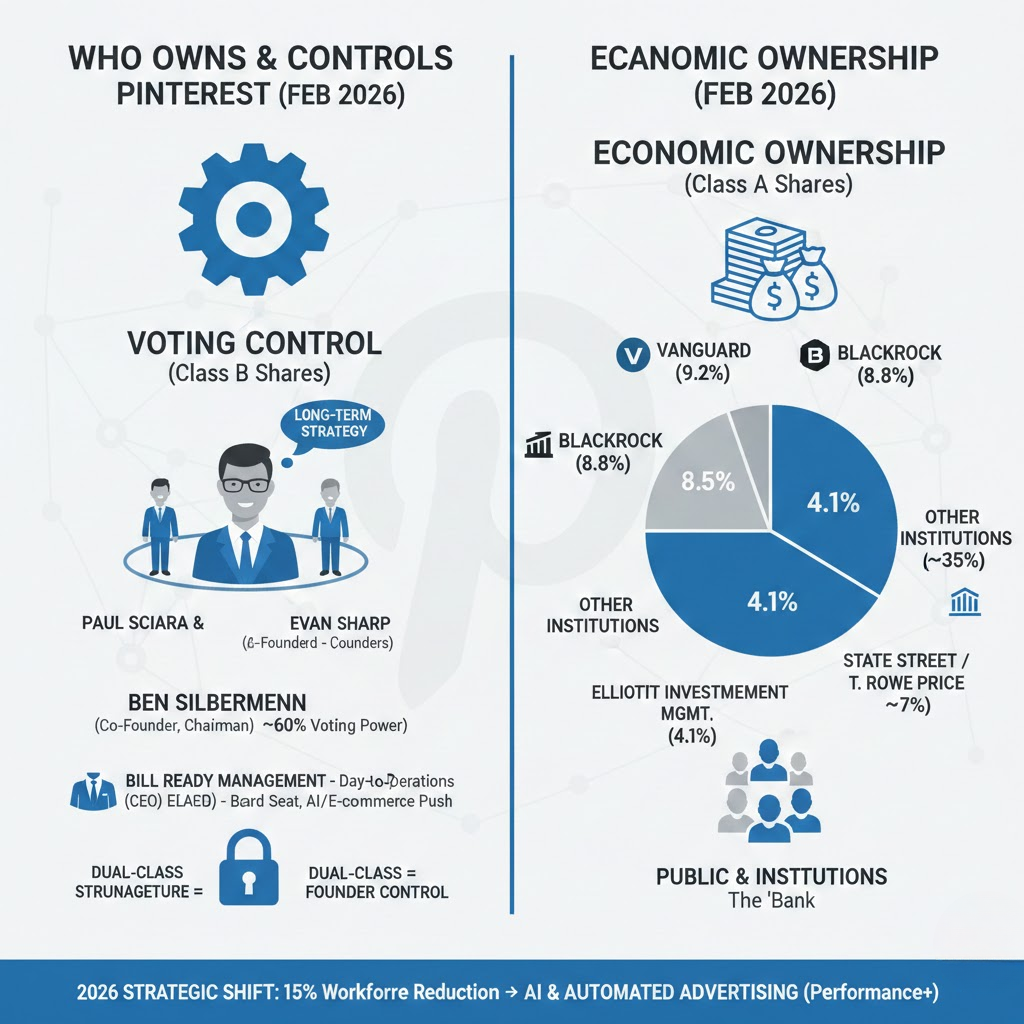
Because Pinterest has public stock ownership, its largest owners are institutional investors, not individuals.
Major institutional shareholders typically include:
- Vanguard Group
- BlackRock
- Fidelity Investments
- Other asset management firms and pension funds
These institutions manage funds on behalf of millions of people, meaning they represent indirect public ownership, not corporate control.
Key point
Institutional investors may own large percentages of shares, but they do not “run” Pinterest day to day.
Insider and Executive Ownership Explained
Pinterest insiders include:
- Founders
- Executive leadership
- Board members
Executives and insiders often own Pinterest stock as part of compensation packages, aligning leadership incentives with long-term company performance.
CEO ownership stake
Pinterest’s CEO holds shares, but the role’s real power comes from:
- Board approval
- Corporate bylaws
- Voting structures
Ownership alone does not equal full control.
Who Actually Controls Pinterest Decisions?
This is where many articles get it wrong.
Ownership and control are not the same thing.
Pinterest is governed through a structured corporate system involving:
1. Board of Directors
The board has the highest authority. It:
- Appoints and removes the CEO
- Approves major strategic decisions
- Oversees corporate governance
2. Executive Leadership
Executives manage daily operations, product direction, and business strategy.
3. Shareholders
Shareholders vote on:
- Board members
- Major corporate actions
- Certain governance changes
Large shareholders can influence outcomes, but they rarely micromanage operations.
Does Any Company Own or Control Pinterest?
No.
Pinterest is not owned by:
- Meta (Facebook)
- Amazon
- Microsoft
- TikTok’s parent company
Despite frequent rumors, Pinterest has never been acquired and remains an independent company.
Why these rumors exist
- Pinterest’s strategic value in e-commerce and advertising
- Its large user base
- Its data-driven discovery model
However, ownership filings and regulatory disclosures consistently show no controlling external parent company.
How Pinterest Ownership Has Changed Over Time
Early stage (2010–2014)
- Owned primarily by founders and early investors
- Strong founder control
Growth stage (2015–2018)
- Venture capital firms gained equity
- Founder ownership diluted
Post-IPO (2019–present)
- Ownership spread across public markets
- Institutional investors became dominant shareholders
- Governance became more structured and regulated
This evolution is typical for successful Silicon Valley tech companies.
Pinterest Ownership vs Operational Control
A common misconception is that owning stock equals controlling the platform.
In reality:
- Shareholders own equity
- The board governs strategy
- Executives execute decisions
Even large investors cannot directly change:
- Pinterest’s algorithm
- Content policies
- Product features
Those decisions are filtered through corporate governance layers.
Voting Rights and Corporate Governance
Pinterest operates under standard U.S. public company governance rules.
Key governance elements
- One share typically equals one vote
- No founder-controlled super-voting structure
- Decisions require board and shareholder approval
This structure limits unilateral control and reduces takeover risk without a broad consensus.
Can Pinterest Be Bought or Acquired?
Technically, yes—but practically, it’s complex.
For Pinterest to be acquired:
- A buyer would need to purchase a controlling share of stock
- The board of directors must approve the deal
- Shareholders must vote in favor
- Regulatory approvals may be required
Why acquisition is difficult
- Distributed ownership
- High valuation expectations
- Strategic resistance from the board
This makes hostile takeovers unlikely.
Why Pinterest Ownership Matters to Users and Creators
Ownership affects more than stock prices.
For users
- Platform independence
- Content moderation philosophy
- Long-term product direction
For creators
- Monetization tools
- Algorithm stability
- Advertising policies
An independent ownership model allows Pinterest to prioritize long-term growth rather than short-term corporate integration.
Common Pinterest Ownership Myths
“Pinterest is owned by Google.”
False. Google has no ownership stake that implies control.
“The founder owns Pinterest.”
False. Founders are shareholders, not sole owners.
“Pinterest was sold.d”
False. No acquisition has occurred.
“Buying stock means you control Pinterest.”
False. Stock ownership grants limited voting rights, not operational control.
Quick Answers to Key Ownership Questions
Who owns Pinterest today?
Public shareholders, led by institutional investors.
Is Pinterest privately owned?
No, it is a public company.
Who controls Pinterest’s decisions?
The board of directors and executive leadership.
Does any company own Pinterest?
No external company owns or controls Pinterest.
Can Pinterest be acquired?
Yes, but only through board and shareholder approval.
Final Takeaways
Pinterest is owned collectively, not individually. It operates as an independent public company with ownership spread across institutional investors, insiders, and everyday shareholders. Control is balanced through corporate governance, ensuring no single entity dominates the platform.
Understanding who owns Pinterest helps clarify:
- Why does it remain independent
- How decisions are made
- Why acquisition rumors rarely materialize
