

Gaming controllers have become essential tools for both casual and professional gamers, yet connectivity issues often undermine the experience.
The HSS Gamepad offers versatile connection options for PC, mobile devices, and consoles, but many users struggle to optimize its wireless or wired performance. This guide dives into every aspect of HSS Gamepad connectivity, from basic pairing to advanced troubleshooting and performance optimization, providing a complete reference for beginners and advanced users alike.
Understanding HSS Gamepad Connection Types
The HSS Gamepad supports multiple connectivity modes, allowing it to adapt to different devices and user needs. Knowing the differences and limitations of each connection type ensures smooth gameplay and minimal latency.
Bluetooth Pairing Guide for Android & iOS
Bluetooth connectivity is the most flexible option for mobile devices. The HSS Gamepad typically uses Bluetooth 5.0, which supports higher bandwidth, longer range, and lower latency than previous standards.
Steps to pair with Android/iOS:
- Turn on the HSS Gamepad and activate pairing mode (usually via the dedicated button).
- Open your device’s Bluetooth settings.
- Select HSS Gamepad from the list of available devices.
- Confirm the pairing, then test input responsiveness in a simple game or controller test app.
Tips for better performance:
- Keep the controller within 10 meters for a stable connection.
- Avoid interference from other Bluetooth devices, Wi-Fi routers, or microwave ovens.
- On iOS devices, ensure the game supports MFi or external controller input.
USB-C and OTG Connections Explained
For users who want minimal latency, wired connections are superior. The HSS Gamepad supports USB-C and micro USB OTG connections, allowing plug-and-play operation.
Benefits of wired connections:
- Zero input lag
- Stable performance in high-interference environments
- No battery dependency
Connecting via USB-C or OTG:
- Plug the USB-C cable into the controller and the device.
- Wait for automatic driver recognition (on PC) or confirmation (on mobile).
- Open a game or emulator to confirm input functionality.
Also read: Is QuikConsole.com Legit And Worth Trying For Gamers
Multi-Device Connection Capabilities
The HSS Gamepad can pair with multiple devices, but simultaneous usage is limited by firmware design. Many users overlook hidden multi-device pairing modes, which allow quick switching between devices without re-pairing.
Quick-switch workflow:
- Pair with Device A via Bluetooth.
- Pair with Device B separately.
- Use the switch button to toggle between devices during gameplay.
This feature is particularly useful for streamers or gamers who switch between PC and mobile gaming.
Troubleshooting HSS Gamepad Connectivity
Connectivity problems are common but solvable with systematic troubleshooting.
Common Pairing Issues & Fixes
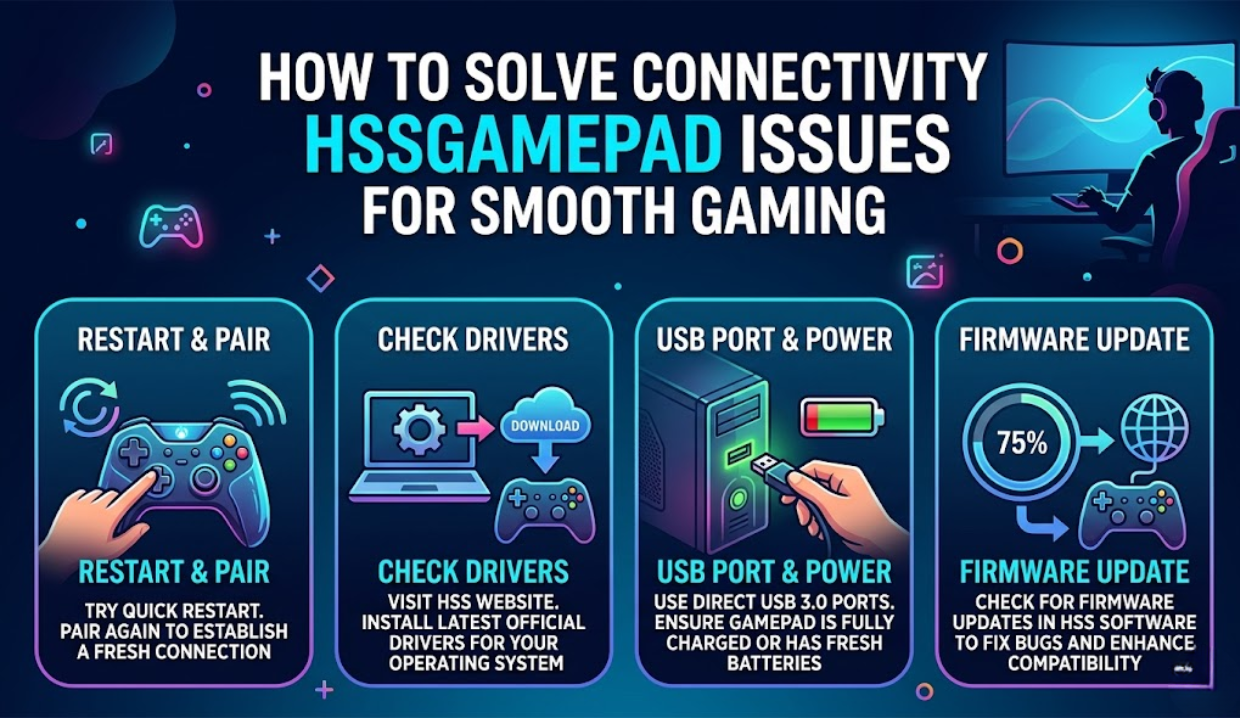
- Device not detected: Ensure Bluetooth is enabled and the gamepad is in pairing mode. Restart the device if necessary.
- Connection drops intermittently: Move away from interference sources, and ensure firmware is up-to-date.
- Input lag or delayed response: Prefer USB or low-latency Bluetooth mode; check for background apps consuming bandwidth.
Signal Stability and Interference Solutions
Wireless interference can come from routers, microwaves, or other controllers. To minimize disruption:
- Maintain a clear line of sight between device and controller.
- Use Bluetooth 5.0 low-latency mode if available.
- Avoid crowded 2.4GHz bands; switch to wired if persistent lag occurs.
Driver & Firmware Update Steps
Firmware updates can solve hidden connectivity issues and unlock advanced features.
Updating steps:
- Visit the official HSS Gamepad support page.
- Download the latest firmware for your device type.
- Follow the installation instructions (USB is recommended for PCs).
- Reboot the controller and test connectivity.
Optimizing HSS Gamepad Performance
Performance optimization enhances gameplay and ensures the controller responds as expected.
Reducing Input Lag
Input lag is the delay between pressing a button and the action appearing on-screen. To reduce it:
- Use wired connections where possible.
- Enable low-latency mode in firmware settings.
- Limit background Bluetooth or Wi-Fi traffic.
Low-Latency Mode and Settings
The HSS Gamepad often includes a low-latency configuration hidden in settings menus. Activating it:
- Reduces polling interval to the device
- Optimizes signal strength
- Improves compatibility with cloud gaming platforms like GeForce Now or Xbox Cloud Gaming
Advanced Calibration Techniques
For competitive gaming, calibration can adjust sensitivity and button mapping:
- Use in-game controller configuration menus.
- Test each button in a dedicated app or emulator.
- Fine-tune analog sticks for precise movement.
Cross-Platform Compatibility Insights
The HSS Gamepad supports multiple operating systems, but there are nuances in setup.
Windows, Linux, and Mobile Integration
- Windows 10/11: Automatic driver installation usually suffices; manual installation may be required for Linux distributions.
- Android: Supports most modern versions with OTG or Bluetooth.
- iOS: Ensure games support MFi or external controllers; pairing can sometimes require multiple reconnections.
Emulator & Cloud Gaming Support
Many gamers use emulators or cloud platforms. The HSS Gamepad is compatible with:
- Retro emulators (NES, SNES, PS1, GBA)
- Cloud services with controller mapping support
- Gaming apps that require HID-compliant input
Hidden Connectivity Features
- Firmware may support multi-device sync, allowing rapid switching between PC, mobile, and console.
- Some versions include encrypted Bluetooth communication for security.
Untapped Connectivity Hacks
Competitors often miss these advanced tips:
- Firmware Rollback: Sometimes older firmware is more stable; rolling back can solve intermittent issues.
- Multi-Device Sync Workflow: Pairing with two devices and toggling reduces repeated setup.
- Latency Benchmarking Tools: Test lag across wired, Bluetooth, and OTG connections to identify the best setup.
- Signal Drop Prevention: Avoid physical obstructions and congested wireless bands.
- Advanced Bluetooth Scanning: Use device-specific apps to detect interference channels.
FAQs About Connectivity HSSGamepad
How do I connect the HSS Gamepad to my Android device?
Turn on pairing mode, enable Bluetooth on Android, and select the HSS Gamepad. Test in a game to confirm responsiveness.
Why is my HSS Gamepad not pairing with Windows 11?
Check for driver updates, ensure the controller is in pairing mode, and disable conflicting Bluetooth devices.
Can the HSS Gamepad connect to multiple devices at once?
Yes, using multi-device sync, but simultaneous active connections are limited. Use the switch button to toggle.
How to fix HSS Gamepad connectivity issues?
Update firmware, check drivers, minimize interference, and test USB connections if Bluetooth fails.
What is the HSS Gamepad Bluetooth range?
Typically around 10 meters, but walls, metal objects, and other devices can reduce effective range.
Does the HSS Gamepad support OTG connections on mobile?
Yes, it supports USB-C and micro USB OTG, offering a wired alternative for minimal latency.
Key Takeaways
The HSS Gamepad is a versatile controller that works across platforms, but optimizing connectivity requires understanding its multiple modes, firmware features, and hidden tricks. By following systematic pairing, troubleshooting, and optimization steps, gamers can:
- Minimize input lag
- Maintain stable wireless or wired connections
- Leverage multi-device sync and hidden low-latency features
- Enhance compatibility with cloud gaming and emulators
Whether you are a beginner seeking seamless mobile play or a competitive gamer optimizing response times, mastering HSS Gamepad connectivity ensures a reliable and immersive gaming experience.
